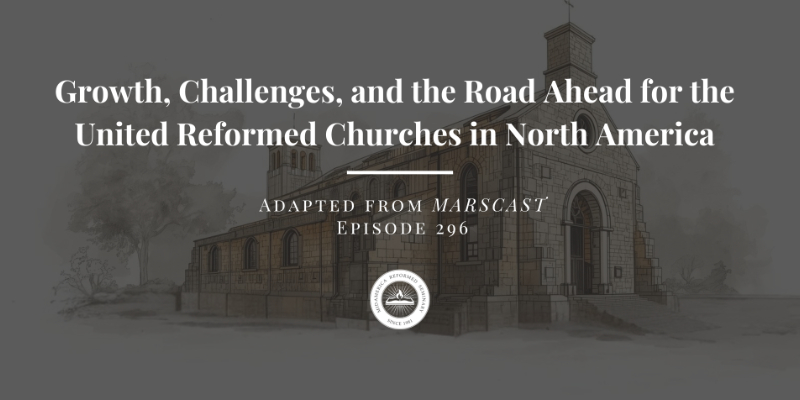
This article is based on a Marscast interview with Dr. Cornelis Venema, President Emeritus and Professor of Doctrinal Studies at Mid-America Reformed Seminary, who continues to serve the United Reformed Churches in North America.
Every church claims to be biblical. Many claim to be Reformed. But what does it actually mean to be a confessionally reformed federation? For the United Reformed Churches in North America, the answer is embedded in historic documents, ecclesiastical structures, and theological commitments that shape everything from worship on Sunday morning to the examination and ordination of ministers.
Why These Confessions?
The URCNA subscribes to the Three Forms of Unity: the Belgic Confession, the Heidelberg Catechism, and the Canons of Dort. Given that the denomination was formed in North America—where the Westminster Standards dominate Presbyterian and some Reformed churches—why choose these continental confessions?
The straightforward answer lies in history. The URC was born from developments in the Christian Reformed Church, which had its roots deeply planted in the Reformation on the European continent, particularly in the Netherlands. But there's more to the story than ethnic heritage or ecclesiastical ancestry.
These three confessions are, in a significant sense, broadly and ecumenically Reformed. The Heidelberg Catechism wasn't written in the Netherlands—it comes from Heidelberg, a German city—and was widely received throughout continental Europe, not just in the Netherlands but also in Germany, Switzerland, and beyond.
The Belgic Confession, despite its name, was written by Guido de Brès, a French Reformed pastor and theologian who had been taught by Calvin. It was modeled after the Gallican Confession of 1559-60 in the French Reformed Church—a confession in which Calvin himself had a hand.
A little-known historical detail: at the time of the meeting of the Synod of Dort, French Reformed theologian Pierre du Moulin requested (in his absence—he'd been warned by French authorities that attending would cost him his life) that the Synod formulate a truly ecumenical statement of the Reformed faith for all Reformed churches, something like the Roman Catholic Church's universal catechism. The Synod's response? We already have one: the Belgic Confession. Even Philip Schaff, the renowned church historian, called the Belgic Confession perhaps the greatest single, relatively brief symbol of the historic Church of the Reformation.
The Canons of Dort were produced at the closest thing to an ecumenical council that Reformed and Presbyterian churches have ever held. Delegates came from England, Scotland, throughout Eastern and Central Europe, France, the Netherlands, and notable theologians from Switzerland. While it isn't a complete statement of the Reformed faith—it addresses one controverted doctrine challenged by the Arminians—it represents the international Reformed consensus of its time.
The Westminster Question
Given the history of the URCNA and its roots, it was never realistic—nor was it necessary—to embrace the Westminster Confession. There was no rejection of Westminster; there was simply no real occasion for its adoption.
Interestingly, in the early history of the Alliance meetings that preceded the URC's formation, the Westminster Confession of Faith was added to the Three Forms as one of the standards for churches represented. There was a sense that this might be a moment in history when divisions among confessionally Reformed churches—even between Reformed and Presbyterian—could be mitigated or overcome.
The situation in North America differed from, for example, New Zealand, where Reformed churches formed after World War II as a four-confession denomination, holding equally to both the Three Forms of Unity and the Westminster Confession. But in that case, the circumstances were unique: confessionally Reformed people from the old Presbyterian Church of New Zealand were leaving together, and in a very small country, Reformed people found each other under duress.
The real differences between Reformed and Presbyterian traditions aren't confessional, but matters of church polity. The CRC came close to an organic union with the Orthodox Presbyterian Church in the late 1950s. Two things prevented it: differences in church order, particularly regarding the membership of ministers in presbytery, and the nature and composition of presbytery versus classis. These are significant polity differences, rather hard to bridge.
But it wasn't a confessional problem. The relationship between the old CRC and the OPC was remarkably close, modeled at Westminster Theological Seminary in Philadelphia, where significant faculty came from the continental tradition—Cornelius Van Til, Ned Stonehouse, R.B. Kuiper. Nothing confessional kept them apart. It was polity. And that remains true today.
The Form of Subscription: How Strict Is Strict?
The form of subscription used in the United Reformed Churches is, in substance and content, exactly the form officially adopted by the Synod of Dort. There are minor language changes—editorial adjustments—but it represents what could be called "strict subscription."
The language of the form states that all the articles and points of doctrine set forth in the Three Forms of Unity are regarded as fully agreeable to the Word of God.
However, there are important qualifiers to understand. The form of subscription doesn't require office bearers to believe the confessions are infallible. Nor must they believe that all doctrines taught in the Word of God are found in the confessions—the confessions are a summary, not exhaustive. Nor must they believe that all errors conflicting with Scripture are refuted in the confessions—many are, but not all.
Furthermore, officers don't have to believe the confessions are articulated in the best possible manner, either in what they affirm or what they reject. They don't even have to agree with all the inferences that others draw from the confessions.
A classic example is the doctrine of common grace. The confessions set boundaries but don't exclude alternative positions or differences of opinion. One can hold a very robust, well-developed doctrine of common grace, or one can say, "I'm not sure I prefer the doctrine in any of its forms." But you cannot argue that someone who affirms the doctrine is thereby denying anything in the confessions.
Recent Examples of Confessional Vigilance
The URC's history illustrates how seriously the federation takes confessional subscription.
At a recent Synod, delegates discussed altering the language of Article 4 of the Belgic Confession, which lists the books comprising the canon. In the original language, the book of Hebrews was attributed to the Apostle Paul. The Synod cleaned this up so that Hebrews was no longer specifically ascribed to Paul.
Dr. Venema mentioned that he would have preferred the Synod simply add a footnote clarifying that the doctrine affirmed in the article concerns which books belong to the canon, not who authored the books, since the ultimate author of all Scripture is the Holy Spirit. The concern about unnecessarily changing the language of historic confessions is legitimate. But the proposed change illustrates the strictness with which the URC views the form of subscription. They didn't want that language to occasion someone saying, "I don't hold to Pauline authorship of Hebrews, therefore I can have a loose view of subscription."
The URC has faced numerous doctrinal issues in its relatively short history:
- The question of creation was addressed at the 1999 synod
- Issues pertaining to paedocommunion (children at the Lord's Table)
- The Federal Vision and reformulation of the doctrine of justification were examined by a study committee whose recommendations were largely approved at the 2010 synod
These cases illustrate that the URC, largely because of its history and background in the CRC, is very resolute about holding people to strict subscription to the confessions and strict adherence to the provisions of the church order.
Dr. Venema quipped that perhaps the denomination went too far at Synod Calgary when it refused to admit a church into the federation because it had only one service on the Lord's Day, out of accord with the church order stipulation for two services. A softer approach might have been taken if the church had promised to eventually move toward a second service, similar to what the CRC did in an earlier period with German Reformed churches.
The Regulative Principle and Catechetical Preaching
Beyond the confessions and church order, other key theological commitments characterize the URCNA. Two stand out: the regulative principle of worship and catechetical preaching.
The regulative principle governs worship in the URC. Simply put, this principle holds that corporate worship should be regulated by what Scripture commands, not by what it doesn't forbid. This stands in contrast to the normative principle, which allows anything in worship that Scripture doesn't explicitly prohibit.
Catechetical preaching—systematic preaching through the Heidelberg Catechism—is expected in URC congregations. Today, when topical preaching dominates, this commitment is decidedly countercultural.
Why are these commitments so important? Because they connect directly to the broader theological vision of the URCNA. Worship isn't a matter of preference or cultural adaptation; it's regulated by Scripture. And the consistent, systematic teaching of the faith through catechetical preaching ensures that congregations are formed not by the latest trends or the pastor's favorite topics, but by the comprehensive scope of Reformed theology as summarized in the Heidelberg Catechism.
Church Order: Structure Serving Doctrine
The church order of the URCNA is rooted in the Church Order of Dort. It provides the ecclesiastical structure and accountability mechanisms that protect doctrinal integrity.
Church order might seem like bureaucratic minutiae—rules about meetings, delegates, and procedures. But in a confessionally reformed church, church order serves doctrine. It establishes how churches relate to one another, how ministers are called and examined, how disputes are resolved, and how broader assemblies function.
The church order works together with the form of subscription to maintain both doctrinal unity and ecclesiastical accountability. The form ensures that all office bearers are committed to the same doctrinal standard. The church order ensures that this commitment isn't merely theoretical but is maintained through proper examination, mutual accountability among churches, and established procedures for addressing doctrinal disputes.
What It All Means
To be a confessionally reformed federation means more than having the right documents on file. It means:
Confessional specificity. The Three Forms of Unity represent specific doctrinal commitments with centuries of Reformed reflection behind them.
Ecclesiastical accountability. Individual congregations aren't autonomous. They're federated together, with mutual responsibilities and structures for addressing doctrinal and ecclesiastical concerns.
Worship is regulated by Scripture. How churches worship isn't a matter of creativity or cultural relevance but of biblical obedience as understood through the regulative principle.
Systematic doctrinal instruction. Catechetical preaching ensures that every generation receives comprehensive instruction in Reformed theology, not just the parts that happen to interest the current pastor.
Strict Subscription. Office bearers make commitments that are taken seriously. The form of subscription is a solemn promise that can and will be enforced through proper ecclesiastical channels.
This is what makes the URCNA distinctively confessional. It's not perfect—as the ongoing work on the church order demonstrates, refinements continue. But the fundamental commitments are clear and, three decades after the federation's founding, remain firmly in place.
The Challenge Ahead
The question for the URCNA going forward is whether these commitments will remain more than historical artifacts. Will younger generations understand why these particular confessions matter? Will the regulative principle continue to shape worship, or will cultural pressures erode it? Will catechetical preaching remain important, or will topical preaching gradually displace it?
The answer will determine whether the URCNA remains what its founders intended: not just another evangelical denomination with a Reformed flavor, but a genuinely confessional federation where doctrine shapes practice, where accountability is real, and where the faith once delivered to the saints is preserved, proclaimed, and passed on to the next generation.
This article is based on a MarsCast interview with Dr. Cornelis Venema, President Emeritus and Professor of Doctrinal Studies at Mid-America Reformed Seminary, who continues to serve the United Reformed Churches in North America.




 229 Seminary Dr. Dyer, IN 46311